Entomology · Public Health · Economics
Mosquitoes have walked alongside humans for over 100 million years — and they remain our single deadliest natural adversary on Earth.
Biology
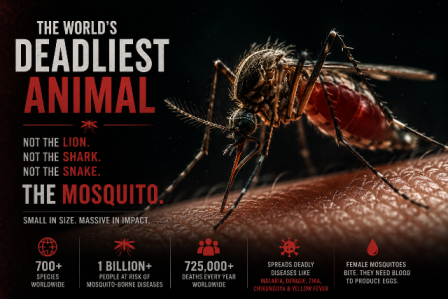
Male mosquitoes feed entirely on nectar and plant juices. Females need the proteins in blood to develop their eggs — you are not food, you are fertilizer.
Females detect the CO₂ you exhale from up to 50 metres away. Once close, they home in on body heat, sweat compounds, and skin bacteria.
Studies show mosquitoes prefer Type O blood — landing on Type O individuals significantly more often than Type A or B. Scientists aren't entirely sure why.
A mosquito's proboscis has 6 separate stylets. Two saw into skin, two hold tissue apart, one draws blood, and one injects saliva — all while numbing the area with its own anaesthetic compound.
Mosquitoes can sense heat with remarkable precision, allowing them to track warm-blooded hosts even in complete darkness.
A raindrop hitting a mosquito in flight is equivalent — by mass ratio — to a bus hitting a human. Yet mosquitoes survive because they simply ride the drop rather than resist it.
Are you a mosquito magnet?
Type O individuals attract significantly more bites than Type A in controlled studies.
Mosquitoes use vision too. Dark colours — navy, black, red — stand out more to them.
After exercise, raised skin temperature makes you dramatically easier to locate.
A single 330ml beer increases attractiveness to mosquitoes, possibly via ethanol in sweat.
Pregnant individuals exhale more CO₂ and have higher skin temperature — a double signal.
The unique blend of bacteria on your skin produces volatile compounds that some mosquitoes find irresistible.
Public health
Economics
The mosquito has generated an entire civilisation of industries. From village-level repellent coils to billion-dollar pharmaceutical pipelines, eliminating this insect would collapse a vast economic ecosystem built around it.
Ecology
Over 725,000 annual deaths from mosquito-borne disease would be prevented, mostly in low-income countries.
Malaria, dengue, Zika, and dozens of other diseases would be effectively eliminated from the transmission chain.
Billions of dollars in healthcare, prevention, and lost productivity would be recovered annually.
Outdoor activity in tropical and subtropical zones would become dramatically safer and more accessible.
Several animal species that currently suffer from mosquito-borne illness (horses, birds, livestock) would benefit.
Thousands of fish, amphibian, and bird species rely on mosquito larvae as a primary food source, particularly in wetland ecosystems.
Some mosquito species are important pollinators — especially in Arctic tundra, where they are among the few flying insects active in summer.
Caribou migration patterns in northern Canada are partly shaped by mosquito pressure — their absence would disrupt grazing behaviour.
Decomposition cycles in wetlands, where mosquito larvae feed on organic matter, would be disrupted.
Ecological vacuum risk — other species would fill the niche, possibly in less predictable or more harmful ways.
Frontier science
CRISPR-Cas9 gene drives can spread a genetic modification through an entire wild population within just a few generations — potentially crashing malaria-carrying mosquito numbers.
British company Oxitec released genetically modified Aedes aegypti males in Florida (2021) and Brazil. Their offspring die before adulthood, suppressing local populations by 70–95%.
Mass-reared sterile male mosquitoes are released to mate with wild females, producing no offspring. This older method, used since the 1950s, is now being scaled with drone delivery systems.
Infecting mosquitoes with Wolbachia bacteria blocks dengue, Zika, and chikungunya replication inside the insect. Field trials in Australia and Indonesia showed 77% reduction in dengue cases.
Did you know?
Engineers studying the mosquito's six-part proboscis used it as inspiration for less painful needle designs — including microneedle patches now in clinical trials.
Male and female mosquitoes adjust their wing-beat frequencies to match each other — a form of acoustic courtship. The familiar whine is them synchronising in mid-air.
Fossil mosquitoes discovered in Burmese amber predate the extinction of non-avian dinosaurs. A blood-filled mosquito fossil was found in Montana shale dating to 46 million years ago.
High-speed cameras revealed that mosquitoes don't avoid raindrops — they attach to them and detach almost immediately, absorbing the impact through wing and leg flexibility.
Of ~3,500 known mosquito species, only about 200 feed on humans. Many species exclusively target birds, reptiles, amphibians, or even invertebrates like earthworms.
Male mosquitoes and non-biting females feed only on nectar and plant sugars, actively pollinating certain bog orchids and other flowers — particularly in far northern ecosystems.
Specialised olfactory receptors on their antennae detect carbon dioxide plumes from your breath. Once within 10 metres, heat and moisture sensors take over for final approach.
More soldiers died from malaria than combat in World War II's Pacific theatre. The conquest of yellow fever enabled the building of the Panama Canal — after it had already killed 22,000 workers under French management.