⚡ Live Hazard Zone
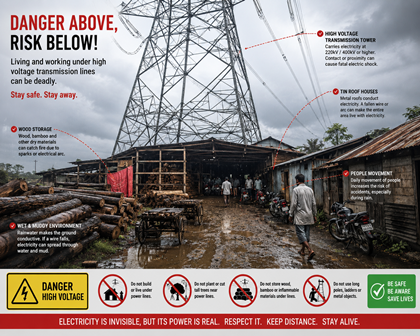
High tension transmission tower with timber yard directly beneath — Bishnupur, West Bengal

Public Safety Awareness

The Tower Above
The Risk Below

This photograph highlights a potentially hazardous situation where people live and work close to a high-voltage transmission corridor — a reality shared by thousands of communities across rural and semi-urban India.

When A High-Voltage Line Falls

• Never run toward the scene. • Stay at least 30 metres away. • Do not touch fences, vehicles, metal roofs or wet objects nearby. • Warn others immediately. • Call emergency services and the electricity authority. Remember: The wire is not the only danger. The ground itself may be energized.
≥220 kV — Estimated line voltage
Higher risk during monsoon
⚠️ Safety clearance must be maintained

⚠️ Public Safety Notice: High-voltage transmission corridors require prescribed safety clearances under Indian electricity regulations. Living, working, storing materials, or constructing structures too close to transmission lines may significantly increase the risk of serious accidents and may be in contravention of the Central Electricity Authority (CEA) safety norms.

The Scene

What This Photograph Shows

A massive high-voltage transmission tower — likely a 220 kV or 400 kV line — stands directly over a working timber yard. Heavy logs are stacked in open ground immediately below the conductors. A covered shed, residential structures with tin roofing, vehicles, and people occupy the same narrow space beneath the tower's footprint. Similar situations exist in many communities around the world where people live and work near high-voltage transmission corridors.

🪵
Timber Yard Below Live Lines

Dry and freshly cut timber is highly flammable. A single electrical arc or sparking event can ignite a catastrophic fire with no safe escape route.

🏠
Residential Structures Nearby

Tin roofs conduct electricity. In the event of a line fault, metal roofing can become lethal even without direct contact with the conductor.

🚒
Emergency Access Blocked

Densely packed materials under a live tower severely limit firefighter and rescue worker access, delaying critical response in any emergency.

👶
Children & Pedestrians

Children playing, workers on foot, and daily commuters pass through the zone regularly — often unaware of the voltage carried just metres above their heads.


How Much Voltage Are We Talking About?

India's transmission network carries voltages that dwarf anything found in a home or office. A single fault can release energy instantly and silently.

0.23 kV
Home supply (230 V)
11 kV
Local distribution line
132 kV
Sub-transmission tower
220 kV
Possible transmission class
400 kV
Inter-state grid line
765 kV
Ultra-high voltage corridor

Why Monsoon Multiplies the Risk

Across South Asia, heavy monsoon rainfall can dramatically increase electrical safety risks.

Wet Ground Conducts

Waterlogged soil dramatically increases electrical conductivity. Stray current from a fallen or faulted line can spread across a wide area of saturated ground.

Standing Water

Flooded yards, ponds, and drainage ditches near the tower become instantly lethal if a high-voltage conductor falls into or near them.

Storm Wind & Debris

Monsoon storms can topple trees, sheet metal, bamboo poles, or scaffolding into live conductors. The tower's clearance zone offers no margin for debris.

Lightning Strike Risk

A transmission tower is a primary lightning target. A strike during a storm can cause a sudden fault, releasing energy along the entire corridor.

⚡ The Hidden Killer: Step Voltage & Touch Voltage

Most people imagine electricity requires direct contact with a wire. High-voltage faults do not work that way.

Step Voltage: When a conductor touches wet ground, dangerous electrical potential spreads outward in rings. Walking across this area — even with no wire in sight — can complete a circuit through your body between one foot and the other.

Touch Voltage: Any metal object — a fence post, a timber loading frame, a vehicle — near a fault point can carry lethal charge. Touching it closes the circuit.

In both cases, you do not need to touch the wire. The wire finds you.

🌳 Trees & High-Voltage Lines Don't Mix

A tree growing near a high-tension corridor is not a natural hazard — it becomes one the moment a storm arrives, or the moment someone picks up a saw.

Why Tall Trees Are Risky

During storms, branches can swing into live conductors. Wet wood and green foliage create a conductive path. High-voltage lines can Arc — jumping to a nearby object without direct contact — through humid air, wet bark, or a leaning branch.

Why Cutting Trees Is Risky

Never cut a tree under or beside a high-tension line on your own. A falling branch or trunk can contact live conductors. Electrical arcing can occur from metres away. This work must only be done by trained personnel with prior permission from the electricity authority.

A common misconception: Many people believe electricity only travels through direct contact. At very high voltages, electrical arcing can occur when objects, branches, equipment, or vegetation come dangerously close to live conductors, especially during humid or wet weather conditions.

Do not plant tall trees within or near the corridor. Do not use bamboo poles, long iron pipes, cranes, or elevated machinery under high-tension lines. One wrong angle — and the current finds a path through you.

Under a High-Tension Tower

⛔ Never Do This

Build or operate a timber yard, fuel store, or any flammable materials depot
Construct homes, shops, or permanent structures within the safety corridor
Stack logs, bamboo, or scaffolding that could fall toward conductors
Plant tall trees or allow large trees to grow near conductors
Cut trees under or beside a live line without official permission and trained crew
Raise long iron pipes, bamboo poles, cranes, or elevated machinery
Let children play, fly kites, or climb structures in the area
Approach a fallen wire or anything it has touched
Enter waterlogged areas near the tower base during or after a storm

✅ Always Do This

Observe the prescribed safety clearance set by the electricity authority
Report any damaged insulator, sagging line, or unusual sparking immediately
Keep the tower base clear of vegetation, debris, and stored goods
Evacuate the area and call emergency services if a wire falls
Inform neighbours — awareness shared is lives saved
Contact your local electricity authority about unsafe encroachments
If a Line Falls or a Fault Occurs —
Do Not Approach. Call Now.

Stay back at least 30 metres. Warn others. Call immediately.

112 National Emergency
101 Fire Service
1912 Contact Local Power Utility
Contact Local Power Utility

The Tower Above. The Risk Below.

Electricity powers homes, industries and progress. But high-voltage transmission corridors are not places for houses, timber yards, tall trees or careless activity. A safe distance today can save a life tomorrow.