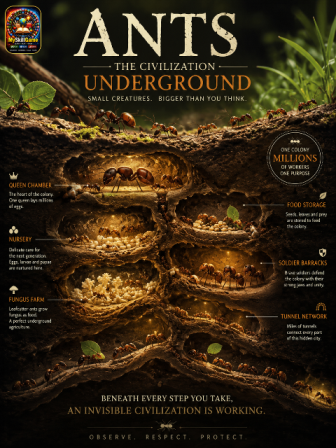
Colony intelligence
A Queen Who Outlives Empires
Worker ants live for a few weeks to a few months — but a queen ant can reign for 20–30 years. In that time she may lay tens of millions of eggs. One Lasius niger queen was recorded living 29 years in captivity — longer than most pet dogs.
Longevity recordOutweighing Humanity
Scientists estimate that all ants on Earth have a combined biomass roughly equal to all humans on the planet. Some estimates say ants outnumber us by a ratio of 2.5 million to 1.
BiomassSuperhuman Strength
Leafcutter ants can carry objects up to 50× their own body weight. If a human had the same strength-to-mass ratio, they could pick up a small car with one hand.
BiomechanicsLiving Bridges & Rafts
Army ants chain their bodies together to form living bridges, ramps, and doorways sized perfectly for the workers passing through. Even more remarkable: when floods hit, they form a living raft that can float for weeks.
Collective behaviourThe Zombie Fungus
Ophiocordyceps unilateralis is a parasitic fungus that hijacks an ant's nervous system, forcing it to climb to an exact height before killing it — optimised for the fungus to spread its spores over the colony below.
ParasitologyFarmers Since Prehistory
Leafcutter ants have been farming fungus for 50 million years — long before humans discovered agriculture 10,000 years ago. They cut leaves to feed a crop, weed it, apply antibiotic bacteria, and eat only the fungus — never the leaf itself.
Agriculture · 50 M yrs oldAnt Dairy Farms
Many ant species "herd" aphids like livestock — protecting them from predators, moving them to fresh plants, and milking them for honeydew by stroking them with their antennae. Some aphid species have become so dependent they can no longer reproduce without ants.
MutualismUnderground Megacities
A single leafcutter ant colony in Brazil was excavated to reveal 8 metres deep, over 1,000 chambers, and corridors spanning the area of a tennis court. The soil moved: 40 tonnes.
ArchitectureAnt Wars & Slavery
Polyergus ants — called "slave-maker ants" — cannot even feed themselves. They raid neighbouring colonies, kidnap pupae, and raise them as workers. Without their captives, the raiders die in days.
Social parasitismDesert Sprinters
The Saharan Silver Ant (Cataglyphis bombycina) survives surface temperatures of 60 °C. It moves at 108 body-lengths per second — if scaled to human size, that's running at 280 km/h.
Extreme biologyNo GPS Needed
Ants navigate using the sun's polarised light, Earth's magnetic field, and scent trails. Desert ants can walk kilometres from the nest, then return in a perfectly straight line — a feat called "path integration."
NavigationExploding Ants
The Camponotus saundersi — or "exploding ant" — can rupture its own body to spray toxic goo over attackers, dying in the act. It's the ultimate self-sacrifice for the colony.
Self-destruction · DefenceChemical Language
Ants have 20+ distinct pheromone signals. They can communicate danger, food location, identity, trail directions, and colony rank — all through chemistry. Their "vocabulary" rivals that of honeybees.
CommunicationAnt Field Medicine
Injured Matabele ants are carried back to the nest by their comrades and treated with secretions. Studies found wounded ants who received treatment had a 90% survival rate; untreated ones mostly died.
First aid · Discovered 2023Fire Ant Invasion
The red fire ant (Solenopsis invicta) has spread to over 50 countries since leaving South America in the 1930s. They cost the US alone an estimated $8 billion per year in damage and control.
Invasive speciesSeed Dispersal Giants
Over 11,000 plant species worldwide depend on ants to disperse their seeds — a process called myrmecochory. Many seeds have a fatty appendage called an "elaiosome" that ants eat, carrying the seed far from the parent plant in exchange.
EcologyPerspective check
"For every human alive today, there are roughly 2.5 million ants — and they have been running complex, cooperative societies for 100 million years longer than we have."
Most remarkable species
By the numbers